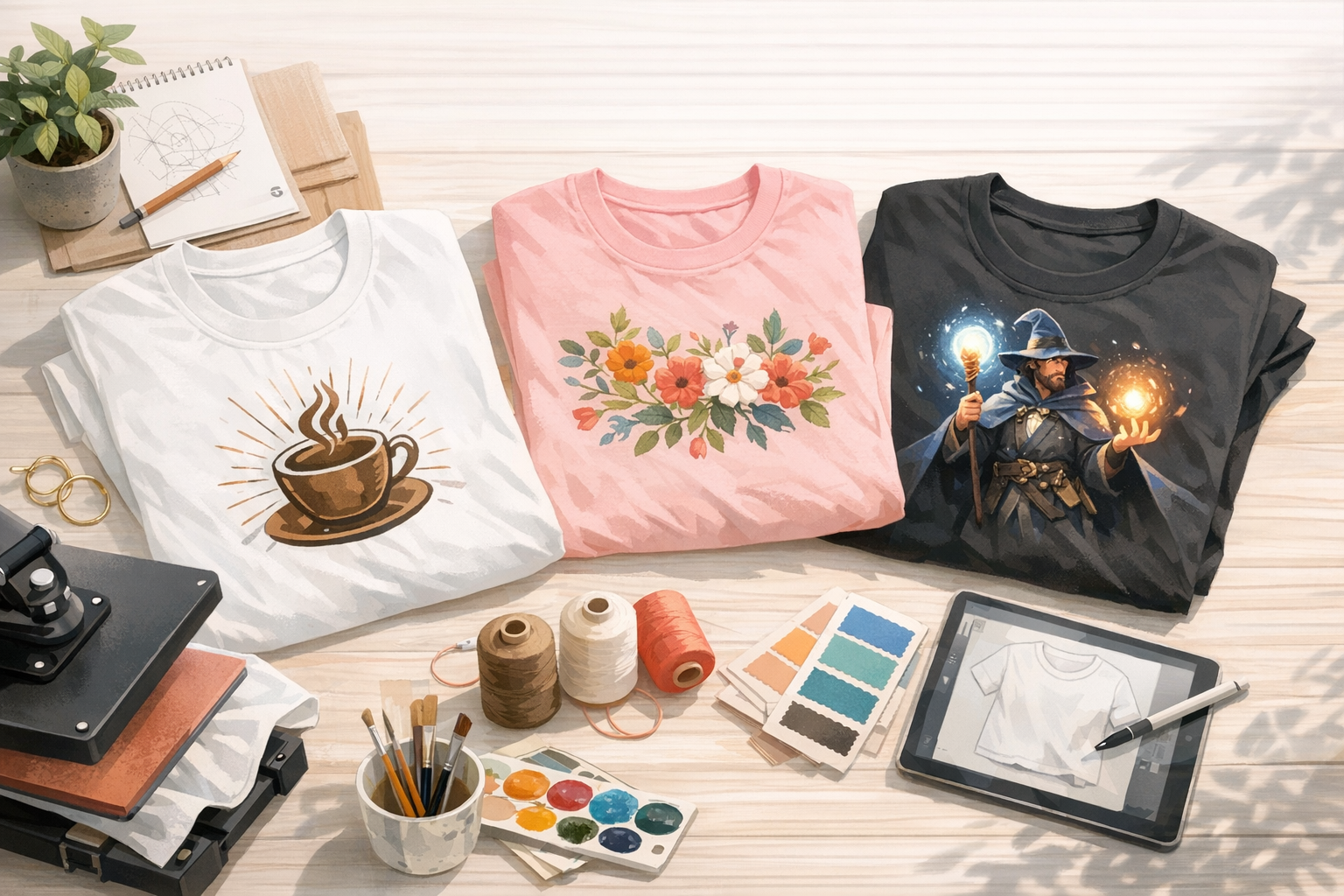
There is one first-timer mistake in this business that costs actual money rather than time, and it is not a pricing mistake. It is putting something on a shirt that belongs to somebody else.
Most people know to avoid the obvious version of that. The version that catches careful people is quieter, and it starts with the fact that the word COFFEE is an active registered trademark for clothing. So is FLORAL. So is SHIRT.
Copyright and trademark are two different laws
The words get used interchangeably and they protect different things.
Copyright covers the work itself: a drawing, a photograph, a character. It exists the moment you make it, you do not register anything, and if you drew your design from scratch you own it. This is the one people worry about, and for original artwork it is usually the one that is fine.
Trademark covers a name, phrase or logo that tells a buyer who made a product. It is registered, it applies country by country, and it only covers particular categories of goods. This is the one that takes listings down, and it lives in the words across the chest rather than in the picture.
Clothing is class 025, and nothing else counts
Trademark registrations are filed against classes of goods. There are 45 of them, and clothing is class 025. A word registered for accounting software or craft beer is not automatically off-limits on a shirt, because a registration only covers what it was registered for.
Which is why "I searched the register and got hits" is not by itself information. The question is always: hits in which class?
Ordinary English words are registered in class 025
Every title we list gets searched against active US registrations in class 025. Words that come back as live clothing marks include SHIRT, FLORAL, COFFEE, EXIST, MONKEYS, CUPID, GIRL, BOAT, DRINKING, IRISH, RANDOM and THINGS.
Registering a word does not remove it from the language. It stops a competitor using that word as a brand on clothing. Putting "coffee" in a sentence about being tired is a different act from selling a shirt whose brand is COFFEE, and the law knows the difference even though a keyword search does not.
The scale of the noise is worth stating plainly. We have run 2,343 of these checks against our own titles. 1,767 of them, roughly three in four, turned up at least one active clothing registration somewhere in the title. 181 came back as a possible problem. On review, 178 of those were cleared and three are still flagged today.
What separates a real conflict from noise
The test we settled on is whether a mark plausibly identifies your design as somebody else's brand. Three questions.
- Is the mark the whole design? A shirt that says nothing but BIGFOOT is trading on the word itself, and BIGFOOT is registered for apparel.
- Is it a multi-word phrase used verbatim as the hook? FRIES BEFORE GUYS is a live registration, so putting it on a shirt as the entire joke is using somebody's brand rather than a common turn of phrase.
- Is the word coined rather than ordinary English? IDGAF is somebody's invention. CUPID is not.
A worked example from our own catalogue: SORCERER is an active clothing registration, and a design of ours called Spreadsheet Sorcerer cleared anyway, because the full phrase reads as a joke about office work rather than as the name of a clothing label. That is a judgment call, and judgment calls are the thing people pay lawyers for. A screen is not a legal opinion and we do not present it as one.
The traps that have nothing to do with words
- Characters, logos, band names and team names. Obvious, and still the most common reason a listing disappears.
- Celebrity faces and names, protected separately again, by publicity rights rather than by trademark.
- Fonts. A font that is free for personal use is not free for commercial use. This is the one that catches the most careful people, because the licence is a text file nobody opens.
- Stock art, brushes and textures carrying editorial-only or no-resale licences.
- AI-generated artwork that reproduces a protected character. That a tool drew it is not a defence.
And one that is genuinely counterintuitive: drawing it yourself does not settle a trademark question. Original artwork answers the copyright question. If the words are somebody's registered mark for clothing, hand-lettering them does not help.
What it costs to get wrong
The listing comes down, usually without a conversation first. Repeat complaints put the whole selling account at risk rather than the one listing, which is the outcome that actually hurts, because it takes every other design down with it. Money already earned can be held or reversed.
And if you bought stock, you now own boxes of something you cannot legally sell. That is why this is the mistake that costs money rather than time.
How it works here
Every title is screened before it goes live: a registry search, a judgment pass on anything substantive, then a person looking at what is left. A flag pulls the product out of the storefront and out of checkout at the same time, so a flagged design cannot end up half-blocked with a page that still takes money.
False positives are real and we have paid for them. Two Halloween shirts came off our own site over the word "pumpkin" before the screen learned to dismiss ordinary words. We fixed the test rather than getting into the habit of overriding flags, because a screen everybody overrides is not a screen.
The honest limit: it reads US registrations in one class. It will not catch everything. What it does is stop the obvious problems before a listing exists, which is cheaper for everybody than finding out afterwards.
Two live examples from the shops we run: the Spreadsheet Sorcerer shirt, which went through exactly the phrase check described above, and a Golden Retriever illustration on Fluffy Doodle, which has no phrase in it at all and therefore none of this particular risk.
The usual caveat stands. Most designs sell modestly or not at all, this is not fast money, and a design that does not sell earns nothing. It also costs nothing: no stock, no listing fees out of your pocket, and nothing in a spare room that a letter can turn into a write-off. If you would rather make the artwork and have the screening, listing and printing handled, you can create a free account, and the money side is set out in full on the payout example page.