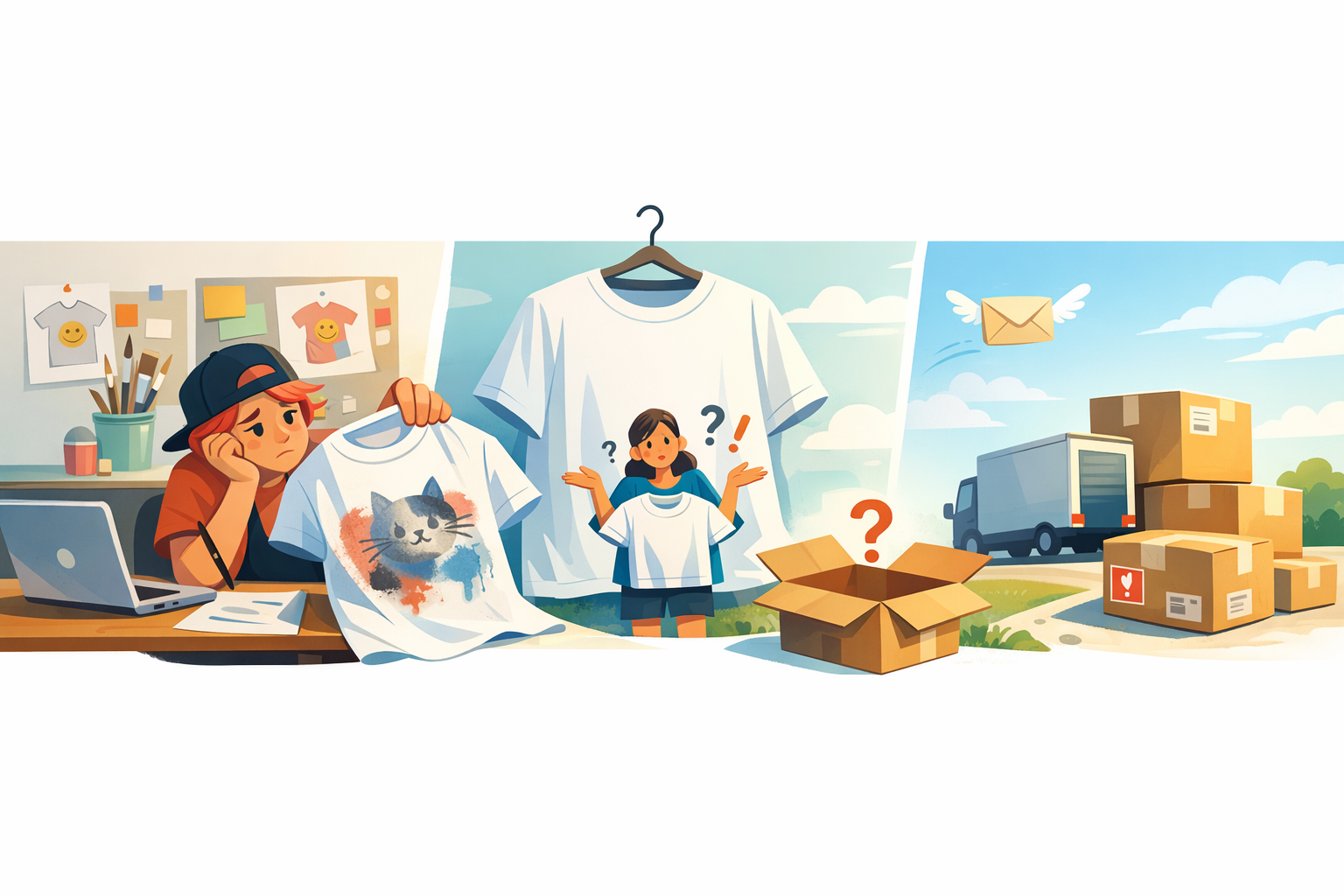
People weigh up print on demand by thinking about the good case. A design sells, money arrives, repeat. The case that decides whether the whole thing is worth doing is the other one: a shirt turns up misprinted, or in the wrong size, or it does not turn up at all. Somebody has to answer that email, buy a replacement, and absorb the cost.
This is the part of the job that is invisible from the outside, so it is worth walking through properly.
Orders go wrong in three different ways, and they are not the same problem
The first is a production defect. The print is off-centre, cracked, faded, or on the wrong colour blank. This one is the cleanest, because it is unambiguously the printer's mistake, and a decent print partner will remake it. It is also the rarest.
The second is a fit or expectation problem. The shirt is exactly what was ordered and the buyer wanted something else: a different fit, a size up, a heavier fabric, a colour that looked different on their screen. Nothing failed. There is simply an unhappy customer, and on most marketplaces they are entitled to a resolution regardless of who was right.
The third is delivery. The parcel is late, is marked delivered and is not there, or goes missing entirely. Nobody in the chain did anything wrong and the buyer still has no shirt. Carrier claims exist and they are slow, and in the meantime the customer expects an answer this week.
Only the first is covered by anybody else. The other two land on the seller, and for most people selling their own designs, the seller is them.
A remake is cheaper than a refund, which is not obvious
Faced with a complaint, the instinct is to refund. It feels like the clean option and it ends the conversation.
It is the more expensive one. The shirt was already printed and posted, so that cost is spent either way. A refund hands back the revenue on top of it. A remake spends the production cost a second time but keeps the original payment.
We checked this against a real order in our own data rather than reasoning about it. Remaking it came out at a net loss of $8.11. Refunding the same order would have been a net loss of $12.74. The gap is roughly the money the buyer paid, which the refund gives back and the remake does not.
There is a caveat worth stating: a remake only works when the customer still wants the shirt. If they have gone cold, a refund is the right answer and the arithmetic does not matter. But the default should be to offer a replacement first, and a lot of first-time sellers refund by reflex and never notice what it costs them across a year.
The cost is real, and it is easy to hide from yourself
A replacement creates a genuinely odd row in the books: full cost, zero revenue, and no new customer. There are two wrong ways to record it, and we managed both in a single afternoon before settling the rule.
Count it as a lost sale and the numbers turn catastrophic, because a whole order's cost is booked as pure loss when the customer did in fact pay. Leave it out entirely and profit looks better than it is, which is worse, because hiding a cost always makes the business look easier than it is.
The rule we landed on is that the cost counts and the unit does not. It is a real expense; it is not a second sale. If you keep your own books, that is the distinction to get right, and it is the one most spreadsheets fumble.
How often does it happen? In our own order history, remakes are uncommon, in the low single digits of orders. That sample is too small to give you a rate you could plan around, and we are not going to dress it up as one. What we can say is that the frequency is low and the cost per event is not, so it is a cost you must model rather than one you can round to zero.
Who carries it in an arrangement like ours
This is the specific reason the whole model exists, so here is the honest version of it.
When a design of yours sells here, you are paid a share of the profit on that sale. If an order goes wrong and we remake it, that remake is our cost. It does not come back to you, there is no bill, and it is not deducted from other sales. If an order is refunded outright, there is no profit on it, so there is no share of it to pay you. Your earnings on that sale go to zero. They never go below zero.
That floor is the entire point. The worst thing a bad order can do to you is fail to earn. It cannot cost you money, because you never bought stock, never paid for printing, and never fronted the postage.
The same asymmetry applies to a design that simply never sells. Nothing happens. There is no shelf of unsold shirts, no listing fees you paid out of pocket, no wasted print run. That is not a promise that your designs will sell. Most designs, ours included, sell modestly or not at all. It is a statement about what failure costs you, which is the number worth knowing before you start.
What the good case looks like
When it works, the output is a listing that exists in the world without you touching it again. Two live examples from the shops we run: a goose shirt on Tickle Stitch and a Labrador shirt on Fluffy Doodle. Each one started as artwork, and everything after that, the listing copy, the pricing, the printing, the customer emails, and yes, the occasional remake, is somebody else's evening.
If you would rather make the artwork and let the returns be somebody else's problem, you can create a free account. The money side is set out in detail on the payout example page if you want to read that first.