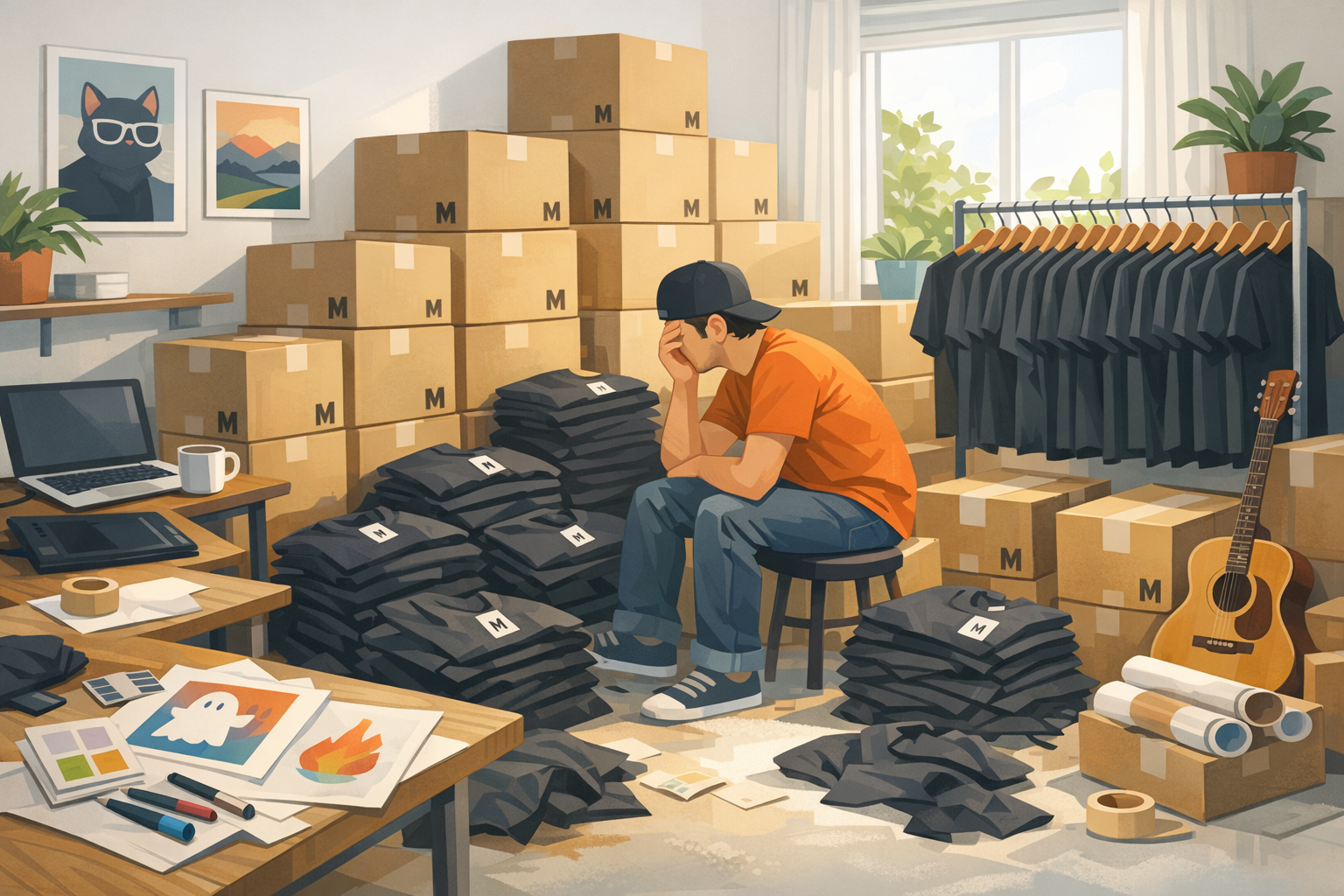
Almost every merch idea dies the same way. Someone has a good design, prices up a bulk order because the per-unit cost looks so much better at 100 pieces, spends six or seven hundred pounds, and ends up with 84 shirts in a spare room. Mostly size M and L, because that is what the supplier's assortment gave them, and mostly in the one colour that seemed safe.
The design was not the problem. The inventory was.
What holding stock actually costs
The obvious cost is the money you spent. The one that does the damage is what that money stops you doing.
Once you have paid for 100 shirts of one design, you cannot test a second design until they sell. You cannot respond to something that starts trending in October, because your capital is sitting in a box. And you are now motivated to defend a design that is not selling, because admitting it was wrong means writing off real money. That last one is worse than it sounds. People discount, run ads, and push a dud for months, spending more on top of the original mistake, because stopping feels like losing.
There is also the part nobody models: you guessed the size curve. Apparel sells across a range, and if you buy 100 units you are betting on a distribution before you have a single data point. Looking at our own order history, sizes S through 3XL all sell in meaningful numbers, with L and M leading and 3XL still a real share. Nobody guesses that split correctly on their first order. You end up sold out of the sizes people want and holding the ones they do not.
Print on demand inverts the order of operations
With print on demand, nothing is made until somebody buys it. The order comes in, the printer produces that one shirt in that one size and colour, and it ships. There is no box in the spare room because there is no box.
The trade is straightforward and you should know it going in: per-unit cost is higher. A bulk-printed shirt might cost you four or five pounds. A print-on-demand shirt costs meaningfully more, because you are paying for a run of one. Your margin per sale is thinner.
What you get for that is the ability to be wrong cheaply. A design that sells nothing costs you the time you spent drawing it. That is the entire downside. And because being wrong is cheap, you can be wrong often, which matters more than it sounds, because nobody can reliably pick winners in advance.
The maths of being wrong cheaply
Say you have ten design ideas and no way of knowing which will work. History says that is roughly accurate: most designs sell very little, a few sell steadily, and occasionally one takes off for reasons you cannot reverse-engineer.
Bulk printing forces you to pick one and bet the whole budget on it. If you pick wrong, you are done, and you have learned almost nothing, because a design that never got in front of anyone has not been tested. It has just been paid for.
Print on demand lets you list all ten. Nine do nothing and cost nothing. The tenth pays for itself. Then you look at what the tenth had that the others did not, and your next ten are better informed. You are running an experiment rather than placing a bet.
This is why volume matters more than perfectionism in this business, and why "I will launch when my design is perfect" is usually a slower route to a worse outcome than launching six things and reading the results.
Where the model does not help
It is only fair to say what print on demand does not fix.
It does not get you traffic. A listing nobody sees sells nothing, whatever the fulfilment model, and this is the part most people underestimate by a wide margin. It does not make a mediocre design sell. And the thinner margin is real: at low volume you will make less per sale than a bulk seller, and if you ever do reach serious volume with a proven design, bulk printing becomes genuinely cheaper and you should switch.
Print on demand is the right tool for the phase where you do not yet know what works. That phase lasts longer than most people expect.
Where we fit
We run print-on-demand shops and we do the operational half for artists who would rather not. You upload a design; we list it, price it, print it, ship it, handle the returns and the customer emails, and pay you a share of each sale. Free to join, and a design that does not sell costs you nothing.
That is the same bargain as above, just with the listing and logistics work taken off your desk too. If it sounds worth trying, create a free account, or read how the money works first.