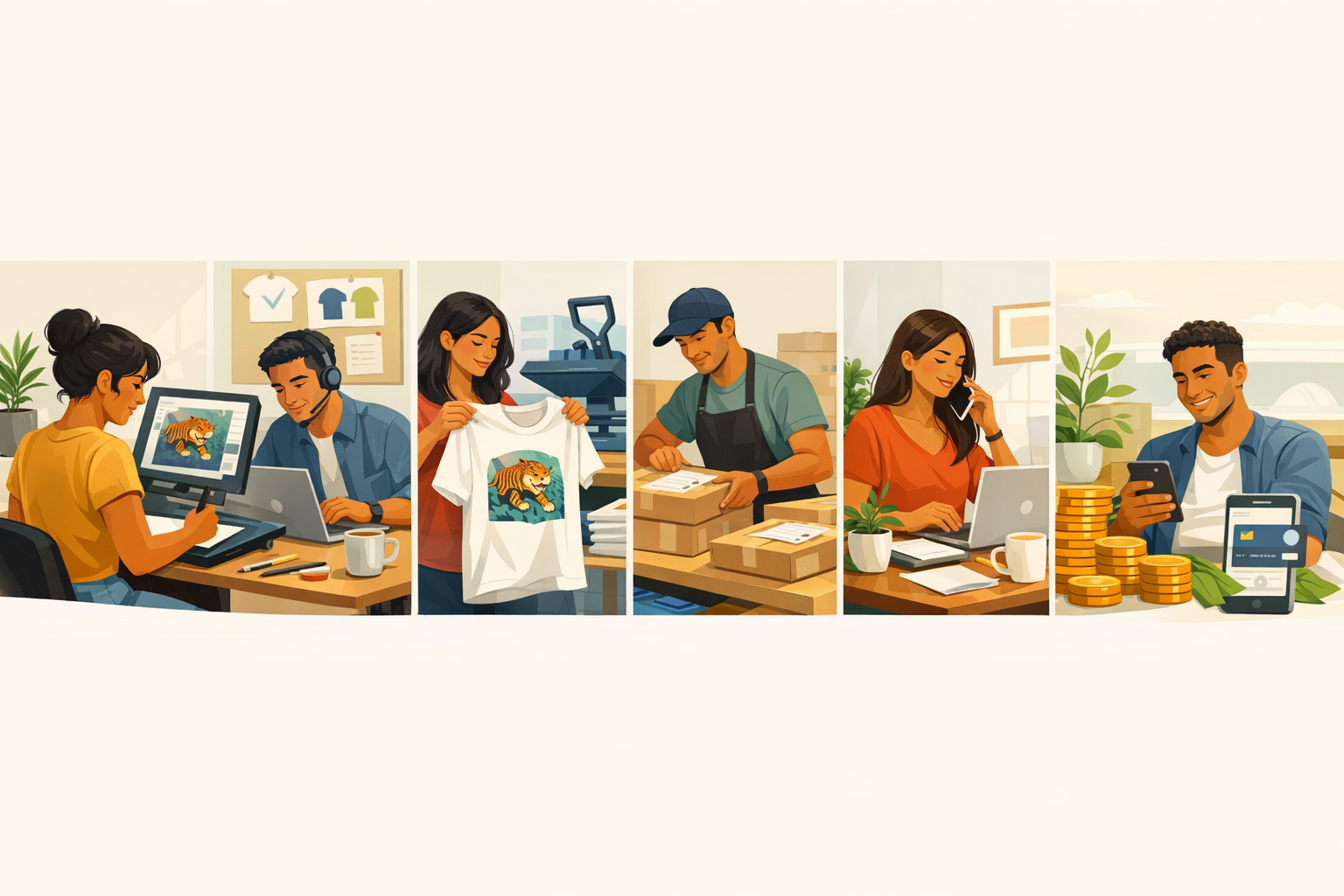
People ask what happens to a design after they upload it, and the honest answer is that quite a lot happens, most of it unglamorous, and almost none of it is design work. This is what the pipeline actually does, in order.
1. The design is checked against what it will be printed on
A design file is not a product. Before anything else, the artwork has to be sized to the print area of a specific garment, positioned, and checked at print resolution rather than screen resolution. Something that looks crisp at 800 pixels wide can be visibly soft at 12 inches across a chest.
Two things get decided here that artists rarely think about. First, whether the design needs a light and a dark version. A design with black linework disappears on a charcoal shirt, so most designs need a second treatment for dark garments. Second, which garment it goes on at all. A heavyweight garment-dyed shirt and a light retail-fit shirt suit different artwork and different price points.
2. It becomes a product, not a picture
The design gets attached to a blank, and that blank has a colour range and a size range. One design becomes dozens of purchasable combinations, each with its own cost, because a 3XL costs more to make than a small and a garment-dyed blank costs more than a basic one.
Then it needs mockups. Nobody buys a flat JPEG of artwork; they buy a picture of a shirt. Those get generated per colour, and the one that leads the listing matters more than the rest, because it is the only image most shoppers ever see.
3. Pricing gets solved backwards
This is the step that surprises people most. You do not pick a price. You pick a margin and solve for the price.
Every sale carries the blank, the printing, the shipping, and the marketplace's cut, and that last one is not a single number. Marketplaces charge a percentage plus a fixed fee, and some of them charge their percentage on the shipping the buyer paid as well as on the item. Amazon changes its referral rate at price thresholds, so a shirt at $19.99 and the same shirt at $20.01 do not pay the same rate.
So the price is calculated per channel, per garment, per size, working back from the margin you need. The same design can legitimately carry different prices on different marketplaces, because the fee structures differ. Anyone who sets one price everywhere is quietly making a loss somewhere.
4. It gets written
A listing needs a title, a description, and keywords, and on most marketplaces the title is not a name. It is the primary thing search matches against, which is why marketplace titles read like keyword runs rather than like sentences. There is a real limit (140 characters on Etsy) and a real cost to wasting it.
The description does two jobs at once: it has to satisfy a shopper who is skimming, and it has to say the specific words a shopper might have typed. Those are different jobs and they fight each other.
5. It is listed, and then it is measured
The listing goes live on the marketplaces. Then the actual work starts, because a live listing is a hypothesis, not an outcome.
What matters after publication is a small number of honest numbers: how many people saw it, how many clicked, how many bought. Those three separate the failure modes cleanly. No views is a discovery problem, and rewriting the description will not fix it. Views but no clicks is usually the lead image. Clicks but no sales is price, or a mismatch between what the listing promised and what the page delivered.
Most listings, honestly, get very few views. That is the normal condition of a new listing in a crowded marketplace, and it is why volume and patience beat polish on any single design.
6. Somebody buys it, and the boring part begins
An order arrives. It has to reach the printer with the right size, colour and address; it gets produced and shipped; the tracking has to get back to the buyer; and if it arrives wrong, somebody has to sort that out and pay for it.
Then the money has to be split correctly: the marketplace takes its fee, the printer and postage take theirs, tax gets handled where it is owed, and what remains is the profit that gets shared.
Why this list matters
Count how many of those steps are design work. One, and part of another.
That ratio is the entire reason platforms like ours exist. It is not that the other steps are hard, exactly. It is that there are a lot of them, they never stop, and they are completely different work from the thing you are actually good at. Plenty of people are happy to learn all of it, and that is a legitimate path. Plenty of others tried, found they were spending their evenings on fee spreadsheets instead of drawing, and stopped.
If you would rather do step one and skip the rest, that is what we handle. Create a free account, or see how the split works first.